
Lalit Manam, Venu Madhav Govindu
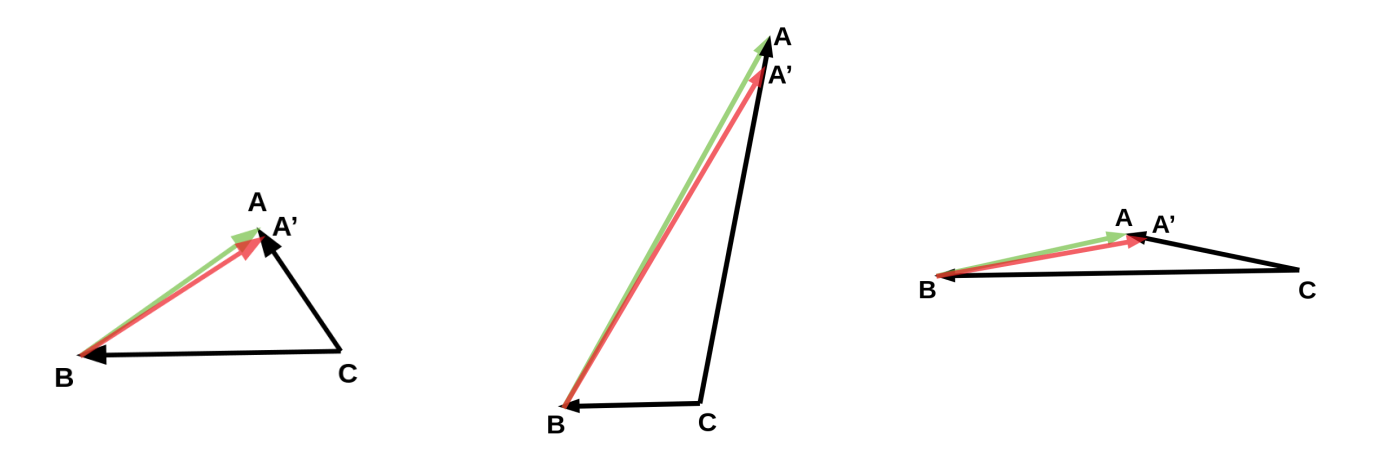
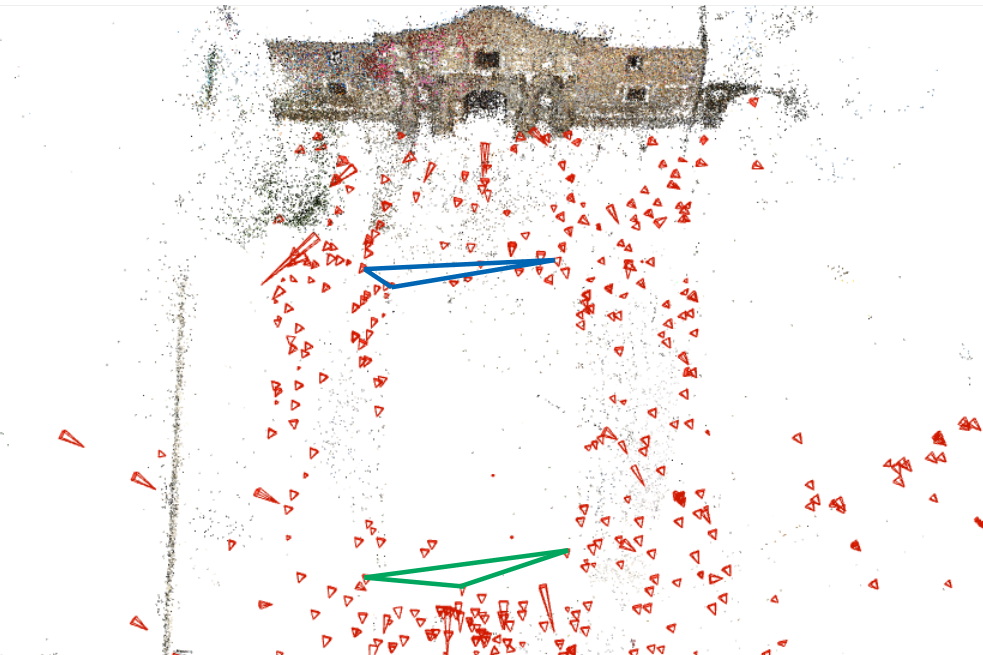
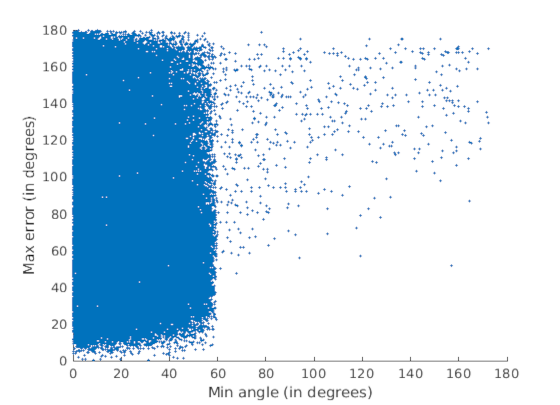
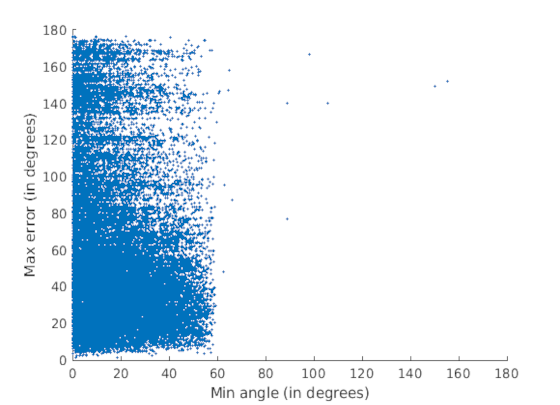
In 3D computer vision, translation averaging solves for absolute translations given a set of pairwise relative translation directions. While there has been much work on robustness to outliers and studies on the uniqueness of the solution, this paper deals with a distinctly different problem of sensitivity in translation averaging under uncertainty. We first analyze sensitivity in estimating scales corresponding to relative directions under small perturbations of the relative directions. Then, we formally define the conditioning of the translation averaging problem, which assesses the reliability of estimated translations based solely on the input directions. We give a sufficient criterion to ensure that the problem is well-conditioned. Subsequently, we provide an efficient algorithm to identify and remove combinations of directions which make the problem ill-conditioned while ensuring uniqueness of the solution. We demonstrate the utility of such analysis in global structure-from-motion pipelines for obtaining 3D reconstructions, which reveals the benefits of filtering the ill-conditioned set of directions in translation averaging in terms of reduced translation errors, a higher number of 3D points triangulated and faster convergence of bundle adjustment.
| |
|
|
| Piccadilly |
Tower of London |
Union Square |
Corrigendum
The corrected statement for Theorem 4 in the NeurIPS 2023 paper is as follows and is also shared in this pdf:
Let \( \mathcal{G} \) be a bearing-based network with all edges contributing to triplets forming triangles, and its corresponding triplet network denoted as \( \mathcal{G}_T \). Each connected component in \( \mathcal{G}_T \) partitions edges in \( \mathcal{G} \), with each partition of \( \mathcal{G} \) forming a parallel rigid component.
Note: The corrected statement differs from the version in the published paper that it establishes only the parallel rigidity of the components of the bearing-based network arising from the connected components of the triplet networks, and does not claim maximality. The largest connected component in the triplet graph results in a parallel rigid component of the bearing-based network but is not maximal. The proof follows the same arguments as presented in the Appendix, except for the removal of the maximality claim. This correction does not affect any results or conclusions of the paper, as the input networks in the experiments remain parallel rigid.
Publications
- Sensitivity in Translation Averaging , Neural Information Processing Systems (NeurIPS), 2023. [bibtex]
- Sensitivity Analysis in Translation Averaging , IEEE Transactions on Pattern Analysis and Machine Intelligence (TPAMI), 2026. [bibtex]
